March is National Women’s Month, a time to recognize the individuals whose determination and leadership helped reshape industries that were not always built with inclusion in mind. In the world of finance, progress did not happen overnight. It came through persistence, vision, and the courage to challenge long‑standing barriers.
Throughout history, women have played critical roles in expanding access to financial opportunity, strengthening communities, and redefining what leadership can look like. Here are five women whose contributions continue to influence the financial world today:
Louise M. Weiser (1837–1898)
Louise M. Weiser is recognized as the first woman to serve as president of an American bank. Following the death of her husband in 1875, she assumed leadership of the Winneshiek County Bank in Decorah, Iowa — a role she held for nearly two decades.
At a time when women rarely occupied formal leadership positions, Weiser’s stewardship provided stability and continuity for a vital community institution. Her tenure demonstrated that effective banking leadership is rooted in responsibility, trust, and long‑term thinking, values that remain central to community banking today.
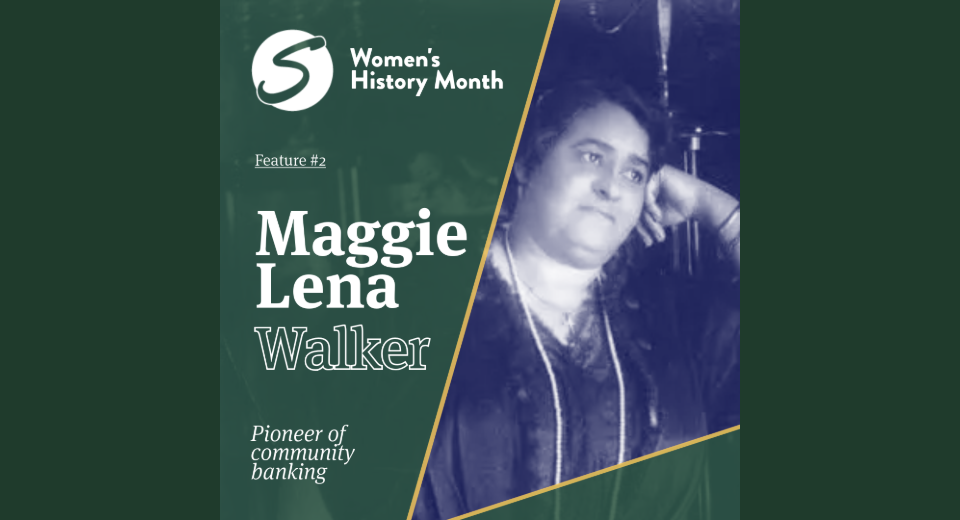
.png "Untitled-2-(2).png") Maggie Lena Walker (1864–1934)
Maggie Lena Walker (1864–1934)
Maggie Lena Walker made history in 1903 when she chartered the St. Luke Penny Savings Bank, becoming the first woman in the United States to found a bank and serve as its president. At a time when both women and African Americans faced systemic exclusion from financial institutions, Walker created a bank rooted in community empowerment.
Through St. Luke’s, she encouraged individuals to save, build stability, and invest in their own futures. By the 1920s, the bank served tens of thousands of members and remained resilient even during the financial turmoil of the Great Depression. The institution later evolved into what is now The Consolidated Bank and Trust Company, still operating in Richmond, Virginia.
Walker’s legacy is a powerful reminder that banking can be a force for opportunity when access and trust come first.
 Madame C.J. Walker (1867–1919)
Born Sarah Breedlove to formerly enslaved parents, Madame C.J. Walker built one of the most successful businesses of her era through innovation, resilience, and self‑belief. After developing hair‑care products to address her own scalp condition, she created a line specifically designed for Black women — an underserved market at the time.
Through the Madame C.J. Walker Company, she became the first self‑made female millionaire in the United States. Beyond business success, Walker emphasized financial independence, job creation, and education, employing and empowering thousands of women across the country.
Her story illustrates how entrepreneurship and financial confidence can create generational impact.
.png "Untitled-2-(1).png") Muriel “Mickie” Siebert (1928–2013)
Muriel “Mickie” Siebert (1928–2013)
In 1967, Muriel Siebert changed the landscape of American finance by becoming the first woman to purchase a seat on the New York Stock Exchange. At the time, she was the only woman among more than a thousand male members on the trading floor.
After experiencing persistent pay inequity early in her career, Siebert founded her own brokerage firm and later went on to serve as Superintendent of Banking for the State of New York. Known for her determination and candor, she famously said that when barriers refuse to move, sometimes you have to push through them yourself.
Her career helped open doors for future generations of women in financial leadership.
.png "Untitled-2-(3).png") Janet Yellen (1946– )
Janet Yellen (1946– )
Janet Yellen represents a modern milestone in economic leadership. Over the course of her career, she became the first woman to serve as Chair of the Federal Reserve, Chair of the Council of Economic Advisers, and U.S. Secretary of the Treasury.
Widely respected for her expertise and steady approach, Yellen has guided national economic policy through periods of significant challenge and change. Her leadership reflects the growing recognition that strong financial systems benefit from diverse perspectives and thoughtful decision‑making.
.png "Untitled-2-(4).png") Looking Ahead
Looking Ahead
Each of these women contributed to finance in different ways; through community banking, entrepreneurship, regulatory leadership, or national economic policy. What unites their stories is a commitment to progress built through responsibility, persistence, and service.
As we recognize National Women’s Month, we honor the women who helped shape the financial world, and reaffirm the importance of creating systems where opportunity, trust, and inclusion continue to grow.


